
When Trust Has Been Broken
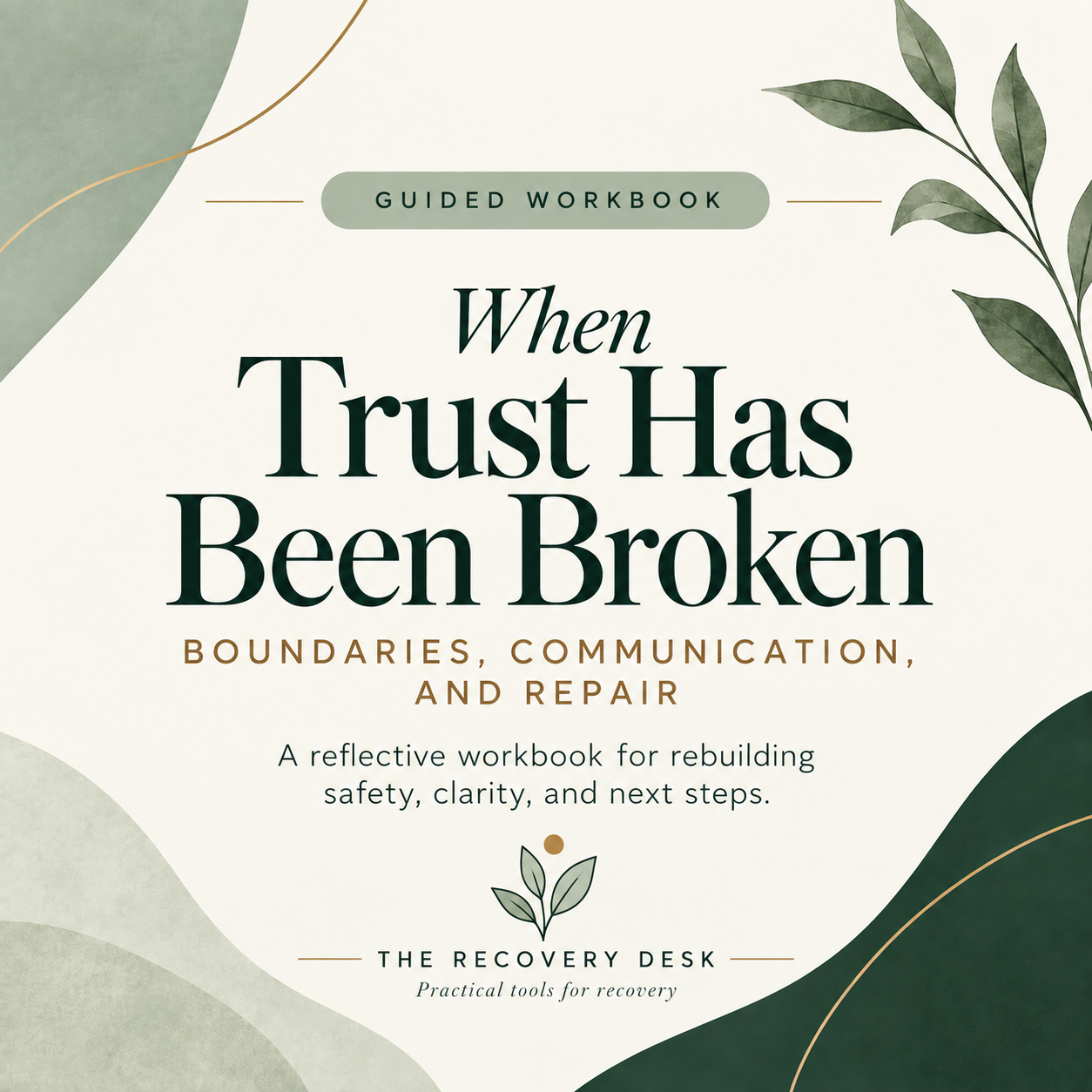
When Trust Has Been Broken
A Practical Family, Relationships & Trust-Building Workbook | 15-Page Printable PDF
When someone you care about struggles with substance use, rebuilding trust can be one of the most challenging parts of the journey.
Perhaps you've experienced broken promises, secrecy, financial difficulties, or situations that have left you questioning what to believe.
You may find yourself constantly worrying, checking for signs of substance use, or wondering whether you can trust what your loved one tells you.
At the same time, you might want to support their recovery without becoming responsible for monitoring every decision they make.
When Trust Has Been Broken is a practical, 15-page guided workbook designed for family members, partners, and loved ones navigating uncertainty and damaged trust in relationships affected by substance use.
Through five focused chapters, realistic examples, guided reflection exercises, and printable worksheets, this resource helps you distinguish between facts and assumptions, identify meaningful steps toward rebuilding trust, establish personal boundaries, and communicate your concerns without relying on surveillance or confrontation.
The workbook also encourages you to reconnect with your own needs, relationships, and sources of support while deciding what a healthier path forward may look like for you.
You do not need to have every answer or make a final decision about your relationship before beginning.
WHAT'S INCLUDED?
1. Separating Observations From Assumptions
When trust has been damaged, everyday situations can bring up worry, suspicion, or uncertainty.
A missed phone call, an unexplained expense, or a change in someone's behaviour may feel concerning, particularly when similar experiences have occurred in the past.
This chapter helps you distinguish between what you know, what you suspect, and what requires a practical response.
Explore:
- Identifying observable facts without immediately assigning meaning.
- Recognizing how previous experiences may influence your interpretations.
- Exploring the emotional impact of uncertainty.
- Identifying practical concerns that need attention.
- Responding to situations without relying on constant monitoring or surveillance.
Includes a printable fact, meaning, and need worksheet to help you organize your thoughts and identify one realistic next step.
2. Identifying Meaningful Steps Toward Rebuilding Trust
Rebuilding trust may involve more than receiving an apology or hearing a promise that things will change.
This chapter encourages you to consider what meaningful, observable follow-through could look like within your relationship.
Explore:
- Identifying specific commitments that affect your wellbeing.
- Considering what consistent follow-through would look like.
- Developing realistic requests around finances, communication, and shared responsibilities.
- Recognizing which decisions remain outside your control.
- Identifying actions you can take to protect your own needs if an agreement is not maintained.
Includes a guided worksheet for developing one realistic request and one self-protective action.
3. Establishing Boundaries Without Using Punishment
When trust has been broken, it can be difficult to distinguish between protecting yourself and attempting to control another person's behaviour.
This chapter explores how to establish personal boundaries that focus on your own safety, wellbeing, finances, and emotional needs.
Explore:
- Identifying situations that require personal boundaries.
- Developing clear and realistic actions within your control.
- Distinguishing boundaries from threats or punishment.
- Considering how to protect your financial and emotional wellbeing.
- Identifying appropriate support when situations involve threats or coercion.
Includes a printable worksheet for developing a personal boundary with a clear situation, action, and support option.
4. Communicating Concerns Without Demanding a Confession
Difficult conversations about substance use, secrecy, and broken trust can become emotionally exhausting.
You may want answers, reassurance, or an explanation for something that has happened.
However, demanding complete certainty or repeatedly questioning another person may not resolve the practical concerns affecting your wellbeing.
This chapter helps you prepare conversations that focus on observable situations, specific needs, and realistic next steps.
Explore:
- Identifying what you want to accomplish through a conversation.
- Preparing clear and respectful statements about your concerns.
- Choosing a time that may reduce unnecessary conflict.
- Asking open questions without demanding disclosure.
- Identifying actions you can take even when another person does not provide the answers you want.
Includes a guided worksheet for preparing a brief conversation opener and a respectful exit statement.
5. Reconnecting With Your Own Needs and Support Systems
When someone you love is experiencing substance use difficulties, your own needs can gradually become less visible.
You may spend significant time worrying about their decisions, trying to understand their behaviour, or managing the effects of ongoing uncertainty.
This chapter encourages you to reconnect with your own wellbeing while considering what support and information you may need.
Explore:
- Recognizing personal needs that may have been overlooked.
- Reconnecting with friendships, activities, and meaningful routines.
- Identifying independent sources of emotional and practical support.
- Considering when professional financial, legal, or relationship guidance may be helpful.
- Exploring your options without feeling pressured to make an immediate decision about your relationship.
Includes a printable worksheet for creating a two-week wellbeing and information-gathering plan.
ADDITIONAL PRINTABLE PLANNING TOOLS
The workbook also includes two reusable worksheets designed to help you navigate difficult situations and prepare meaningful conversations.
Your Situation-to-Action Map
A practical planning page for identifying your current circumstances, immediate needs, available support, and one realistic action you can take within the next 24 hours.
Use this worksheet whenever a new situation arises or you need to organize your next steps.
A Conversation I Can Actually Use
A guided script-building worksheet to help you prepare a difficult conversation with your loved one.
Use it to identify what you want to communicate, develop a specific request, and consider what you can do if your preferred outcome is unavailable.
The worksheet also encourages you to identify appropriate support if a conversation becomes unsafe or overwhelming.
WHO IS THIS WORKBOOK FOR?
This resource may be particularly helpful for:
- Partners and spouses navigating damaged trust in relationships affected by substance use.
- Family members who have experienced secrecy, broken promises, or uncertainty involving a loved one's substance use.
- Individuals who want to support someone in recovery without becoming responsible for monitoring their behaviour.
- People experiencing ongoing worry about whether a loved one has returned to substance use.
- Individuals looking to establish boundaries around shared finances, household responsibilities, and communication.
- People seeking practical ways to communicate their concerns while respecting their own wellbeing.
- Family members and loved ones who want to reconnect with their personal needs and support systems.
The workbook is designed primarily for the person experiencing damaged trust, rather than as a tool for investigating or monitoring someone else's substance use.
It can be completed independently or alongside a trusted support person or appropriate professional.
HOW TO USE THIS WORKBOOK
You do not need to complete every chapter in order.
If you're struggling with uncertainty about a recent situation, you might begin with the fact, meaning, and need worksheet.
If you're considering what rebuilding trust could look like, you may prefer to explore the chapter on observable commitments and follow-through.
If you're preparing for a difficult conversation, the communication and boundaries exercises may be useful starting points.
If you've been spending most of your time focusing on your loved one's behaviour, the personal support planning section can help you reconnect with your own needs.
Each chapter includes practical information, a realistic example, guided reflection questions, and a specific planning exercise.
Choose the sections that fit your circumstances, work at your own pace, and return to the worksheets whenever your situation changes.
PRODUCT DETAILS
- Format: Digital PDF download
- Length: 15 pages
- Includes: 5 guided chapters
- Materials: Printable reflection worksheets, trust-building exercises, realistic examples, personal boundary planning, communication tools, and reusable planning pages
- Language: English
- Delivery: Instant digital download
- Use: Printable for personal use
No physical product will be shipped.
YOU CAN CARE ABOUT SOMEONE WITHOUT LOSING SIGHT OF YOURSELF.
Rebuilding trust after difficult experiences can take time, and there may not be a simple answer to every question you have.
You can care about someone's recovery while recognizing that your own safety, stability, and emotional wellbeing also matter.
Sometimes, moving forward may involve communicating a clear boundary, requesting specific follow-through, seeking independent support, or deciding what you need from a relationship.
When Trust Has Been Broken is designed to help you explore these decisions without expecting you to monitor another person's every action or immediately resolve every uncertainty.
You can take time to understand your needs, identify realistic steps, and decide what rebuilding trust means within your own circumstances.
Your concerns matter. Your boundaries matter. Your wellbeing matters.
IMPORTANT INFORMATION & LICENSING
This workbook is an educational resource intended for general family support, personal reflection, relationship planning, boundary development, and practical communication.
It does not replace professional medical care, individualized counselling, psychotherapy, relationship counselling, financial advice, legal advice, or emergency services.
The workbook does not provide a method for determining whether another person is using substances, guarantee that trust can be restored, or establish whether a relationship should continue.
If your circumstances involve threats, coercion, violence, or immediate danger, prioritize your safety and seek appropriate professional or emergency assistance.
No worksheet can guarantee personal safety, abstinence, relationship repair, or a particular recovery outcome.
Your purchase includes a digital PDF for personal use only. You may print pages for your own use. Resale, redistribution, uploading the file to shared drives, or marketing adapted copies as your own product is not permitted.