
When Your Loved One Does Not Want Help
When Your Loved One Does Not Want Help
A Practical Family Communication, Boundaries & Support Workbook | 27-Page Printable PDF
It can be incredibly difficult to care about someone who is struggling with substance use when they do not want help.
You may see problems that feel urgent while the other person does not want treatment, does not want to talk, or rejects the support you offer.
Perhaps you find yourself repeating the same concerns, searching for the right words, offering resources again and again, or wondering whether there is something you could say that would finally make them change.
You might also feel stuck between wanting to stay connected and needing to protect your own emotional wellbeing, finances, home, or personal safety.
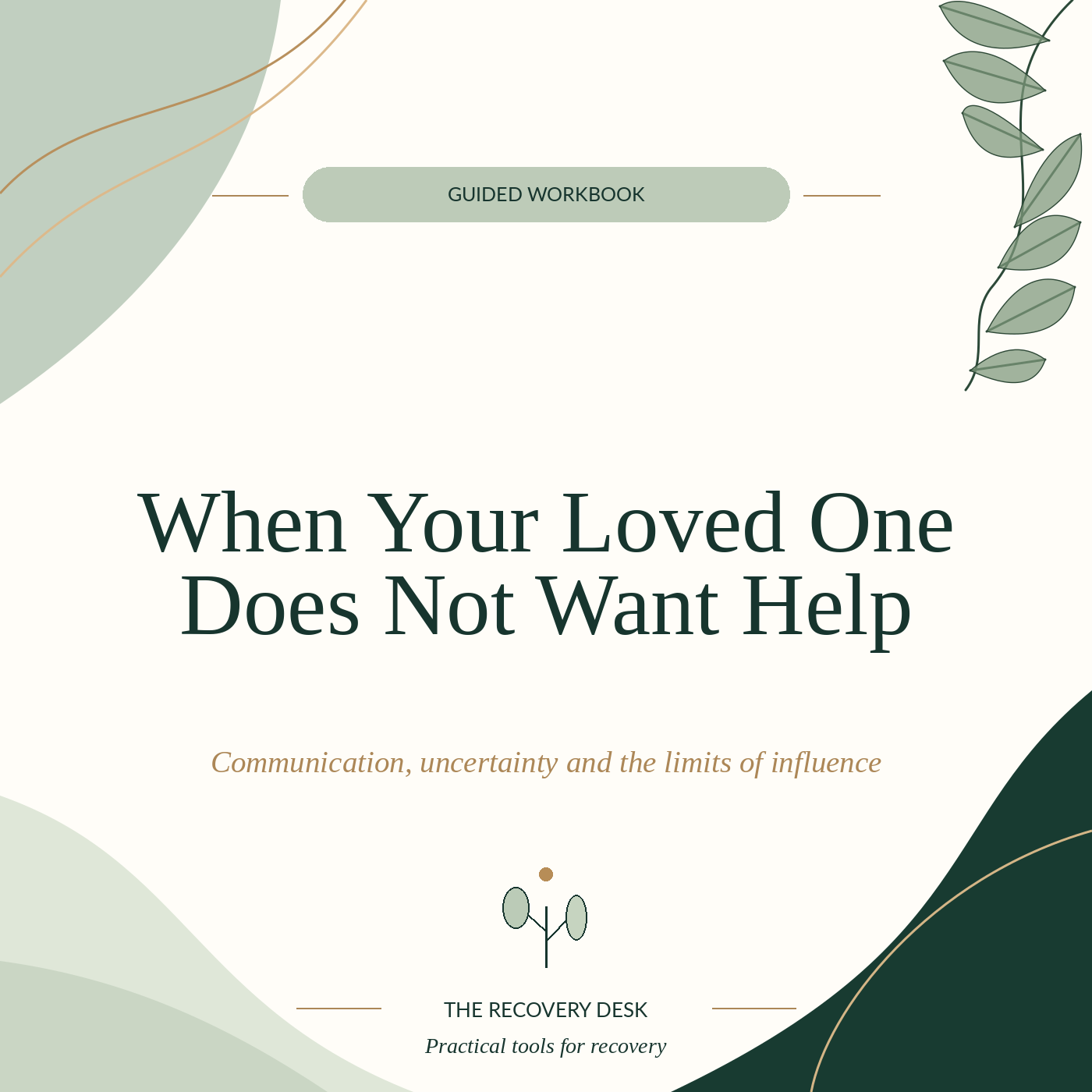
When Your Loved One Does Not Want Help is a practical, 27-page guided workbook designed to help family members, partners, and loved ones navigate communication, uncertainty, personal boundaries, and the limits of influence. 48_when-they-do-not-want-help
Through five focused chapters, fictional examples, guided reflection exercises, personal action plans, and 12 additional guided practice worksheets, this resource helps you distinguish invitation from pressure, communicate concerns without blame, identify your own limits, keep connection possible without chasing or controlling, and develop a personal safety plan when needed.
Rather than promising that the right conversation will make someone accept treatment, this workbook focuses on what is actually within your control.
You can offer information.
You can communicate your concerns.
You can set boundaries.
You can protect your own wellbeing.
But you cannot make another adult want help before they are ready to accept it.
WHAT’S INCLUDED?
1. Distinguishing Invitation From Pressure
There is an important difference between offering help and repeatedly trying to convince someone to accept it.
You may want to provide treatment information, suggest counselling, or offer practical assistance.
The other person may still say no.
This chapter helps you explore how to make an offer without turning it into pressure.
Explore:
- Identifying what your loved one has actually said about wanting help.
- Recognizing when an invitation has become a repeated demand.
- Offering information without attaching conditions.
- Respecting a clear refusal.
- Communicating that support remains available without arguing.
- Recognizing that someone may accept help later, differently, or from someone else.
Includes a guided reflection worksheet and an action-planning exercise for offering information once and accepting the answer.
The goal is not to stop caring.
It is to separate caring from trying to control another adult’s decision.
2. Using Nonjudgmental Observations
When you are worried or frustrated, conversations can quickly become filled with labels, accusations, predictions, or assumptions about motives.
Statements such as “you never care,” “you’re ruining everything,” or “you clearly don’t want to get better” may express real pain but can also make productive conversation more difficult.
This chapter helps you focus on specific events and their impact.
Explore:
- Identifying the exact event you want to discuss.
- Describing what happened without exaggeration.
- Naming your emotional response.
- Explaining practical effects on you or the household.
- Avoiding predictions about another person’s motives.
- Asking questions that invite their perspective.
Includes a guided reflection worksheet and an action-planning exercise for writing a short, factual conversation starter.
The focus is on communicating clearly enough to be heard, not building a case against the other person.
3. Knowing Your Own Limits
When someone does not want help, you may begin to focus almost entirely on what they should do.
This chapter shifts attention back toward the choices that remain yours.
A boundary describes what you will do.
It is not a threat designed to force someone else to change.
Explore:
- Identifying actions that are genuinely within your control.
- Recognizing limits around money, transportation, housing, time, or emotional availability.
- Considering whether a boundary is realistic and sustainable.
- Communicating your limit without debating whether the other person deserves help.
- Recognizing when housing rights, dependent children, or safety concerns require professional guidance.
- Identifying support that may help you maintain your boundary respectfully.
Includes a guided reflection worksheet and an action-planning exercise for stating one personal limit without using a threat.
You do not need the other person to agree with your boundary for it to describe what you will do.
4. Keeping Connection Possible Without Chasing
Someone who refuses help today may feel differently later.
They may also prefer to receive support from someone else or in a different form.
This chapter explores how you might leave a low-pressure pathway for future connection while protecting your own time, energy, and resources.
Explore:
- Identifying what level of contact feels safe and sustainable.
- Recognizing which topics can be left alone for now.
- Offering one resource without repeatedly raising it.
- Considering who else may be able to provide support if invited.
- Setting limits on conversations that repeatedly become harmful or unproductive.
- Creating a future invitation that does not require immediate action.
Includes a guided reflection worksheet and an action-planning exercise for preparing one low-pressure future invitation.
The goal is to keep connection possible where appropriate without making your entire relationship revolve around persuading someone to change.
5. Creating Your Own Safety Plan
Supporting someone does not require remaining in a threatening or unsafe situation.
If threats, coercion, violence, overdose risk, or immediate danger are present, personal safety and professional assistance come first.
This chapter helps you identify what you would do if a situation became unsafe.
Explore:
- Recognizing warning signs that tell you to leave or seek urgent help.
- Identifying where you could go.
- Choosing trusted people or professional services you can contact.
- Preparing practical information or belongings you may need.
- Recognizing when an argument should end rather than continue.
- Understanding that family support does not require remaining in danger.
Includes a guided reflection worksheet and an action-planning exercise for saving two personal safety contacts.
The workbook does not suggest that you confront someone directly when doing so may place you at risk.
YOUR PERSONAL ONE-PAGE PLAN
The workbook also includes a reusable personal planning worksheet designed to help you organize what remains within your control.
This worksheet encourages you to identify:
- What you want to protect or build.
- The earliest sign that your current plan may need to change.
- Two realistic actions within your control.
- A person, service, or place you can contact.
- One manageable action you can take within the next 24 hours.
You can return to this page whenever your loved one’s circumstances, your boundaries, or your own needs change.
12 ADDITIONAL GUIDED PRACTICE WORKSHEETS
The expanded edition includes 12 additional reflection and planning pages designed to help you explore responsibility, uncertainty, communication, boundaries, trust, and your own wellbeing in greater detail.
1. What Belongs to Whom
Distinguish between your responsibilities, your loved one’s decisions, choices that can be made together, and circumstances outside everyone’s control.
2. Facts, Fears and Assumptions
Explore the difference between what you know directly, what you fear may happen, and what you may be assuming.
Identify what information would actually help.
3. Your Needs Matter Too
Reflect on what has become difficult for you, what you need more of, and what support you can seek independently.
4. A Boundary That Protects
Develop a realistic boundary based on what you will do rather than using threats to control another person.
5. Conversation Preparation
Clarify the purpose of a difficult conversation, decide what details can be left out, prepare a respectful opening, and identify when it may be time to pause.
6. Listen Without Agreeing
Explore how to understand another person’s experience without pretending you agree with every decision they make.
7. Plan for Uncertainty
Prepare for more than one possible outcome without trying to predict or control what someone else will do.
8. Your Support Network
Identify personal, professional, and community support for yourself, including people who can listen without increasing panic.
9. Repair and Trust
Explore what meaningful repair may look like over time, what evidence may help trust grow, what privacy still belongs to each person, and what pace feels safe.
10. A Seven-Day Experiment
Choose one small change, decide what you want to observe, and review whether the adjustment supports your wellbeing or communication.
11. When More Help Is Needed
Identify warning signs that require professional or urgent assistance, including overdose, violence, suicide risk, medical emergencies, or situations where home is not safe.
12. Your Next Conversation
Prepare one clear communication step, identify your most important request or boundary, and consider what support you will arrange for yourself afterward.
Each worksheet includes guided reflection questions and space to identify one manageable next step.
WHO IS THIS WORKBOOK FOR?
This resource may be particularly helpful for:
- Parents whose adult child does not want addiction treatment.
- Partners or spouses trying to support someone who refuses help.
- Adult children concerned about a parent’s substance use.
- Siblings, relatives, and friends who feel stuck trying to convince someone to change.
- People who repeatedly offer treatment information without knowing when to stop.
- Individuals struggling to separate support from pressure.
- Family members who want to communicate concerns without blame or interrogation.
- People trying to establish financial, emotional, housing, or communication boundaries.
- Individuals who want to preserve connection without making every interaction about treatment.
- Loved ones who need their own support or safety plan.
The workbook is designed for family members and loved ones rather than as a treatment resource for the person who does not want help.
It can be completed independently.
You do not need your loved one’s participation in order to work on your own communication, boundaries, support network, or safety planning.
HOW TO USE THIS WORKBOOK
You do not need to complete every chapter in order.
If you find yourself repeatedly offering treatment or trying to convince someone to accept help, you might begin with the invitation-versus-pressure section.
If conversations frequently become accusatory or defensive, the nonjudgmental communication exercises may be a useful starting point.
If you are unsure what you can reasonably continue providing, the personal limits section can help you identify actions that remain within your control.
If you want to leave the door open without repeatedly raising treatment, the connection section can help you develop a lower-pressure approach.
If threats, coercion, violence, or immediate safety concerns are present, prioritize the safety-planning section and appropriate professional support.
Each chapter includes practical educational information, a fictional example, guided reflection questions, and a corresponding action-planning exercise.
The 12 additional guided practice worksheets provide further opportunities to explore selected topics and develop realistic personal plans.
Choose the sections that fit your circumstances, skip questions that do not feel relevant or safe, and return to the workbook whenever your needs change.
PRODUCT DETAILS
- Format: Digital PDF download
- Length: 27 pages
- Includes: 5 guided chapters with corresponding action-planning exercises
- Additional materials: 12 expanded guided practice worksheets, a reusable personal planning page, fictional examples, and further-reading resources
- Topics: Treatment refusal, communication, limits of influence, personal boundaries, uncertainty, connection, safety planning, and family support
- Language: English
- Delivery: Instant digital download
- Intended audience: Family members, partners, friends, and loved ones of adults affected by substance use
- Use: Printable for personal use
No physical product will be shipped.
YOU CAN CARE DEEPLY WITHOUT BEING ABLE TO MAKE SOMEONE CHANGE.
When someone you love does not want help, it can feel as though you need to find the perfect argument, resource, consequence, or conversation.
But another adult’s willingness to seek help ultimately belongs to them.
That does not mean you have no choices.
You can communicate honestly.
You can offer support.
You can leave information available.
You can establish limits around your own money, home, time, or emotional wellbeing.
You can seek support for yourself.
And when safety becomes a concern, you can take steps to protect yourself rather than continuing an argument you cannot control.
When Your Loved One Does Not Want Help is designed to help you navigate this uncertainty with practical reflection, realistic boundaries, and respect for both your loved one’s autonomy and your own wellbeing.
Offer support. Respect the limits of influence. Protect your own wellbeing too.
IMPORTANT INFORMATION & LICENSING
This workbook is an educational resource intended for general family support, personal reflection, communication, boundary development, safety planning, and practical decision-making.
It does not replace professional medical care, individualized counselling, psychotherapy, family therapy, clinical assessment, legal advice, financial advice, domestic violence services, or emergency services.
The workbook is not an independently tested or clinically validated treatment intervention.
It should not be used to diagnose another person, pressure treatment participation, impose surveillance, force disclosure, demand reconciliation, or attempt to control another adult’s decisions.
If circumstances involve threats, coercion, violence, dependent children, unsafe housing, or legal concerns, seek appropriate professional or specialist guidance.
If someone is experiencing a suspected overdose, severe withdrawal, a medical emergency, or immediate danger, contact emergency services (911 in Canada or your local emergency number). For suicide crisis support in Canada, call or text 988.
No worksheet can make another person accept treatment, guarantee personal safety, prevent substance use, restore trust, or produce a particular recovery outcome.
Your purchase includes a digital PDF for personal use only. You may print pages for your own use. Organizational distribution, resale, unauthorized redistribution, or marketing adapted copies as your own product is not permitted without separate written permission.