

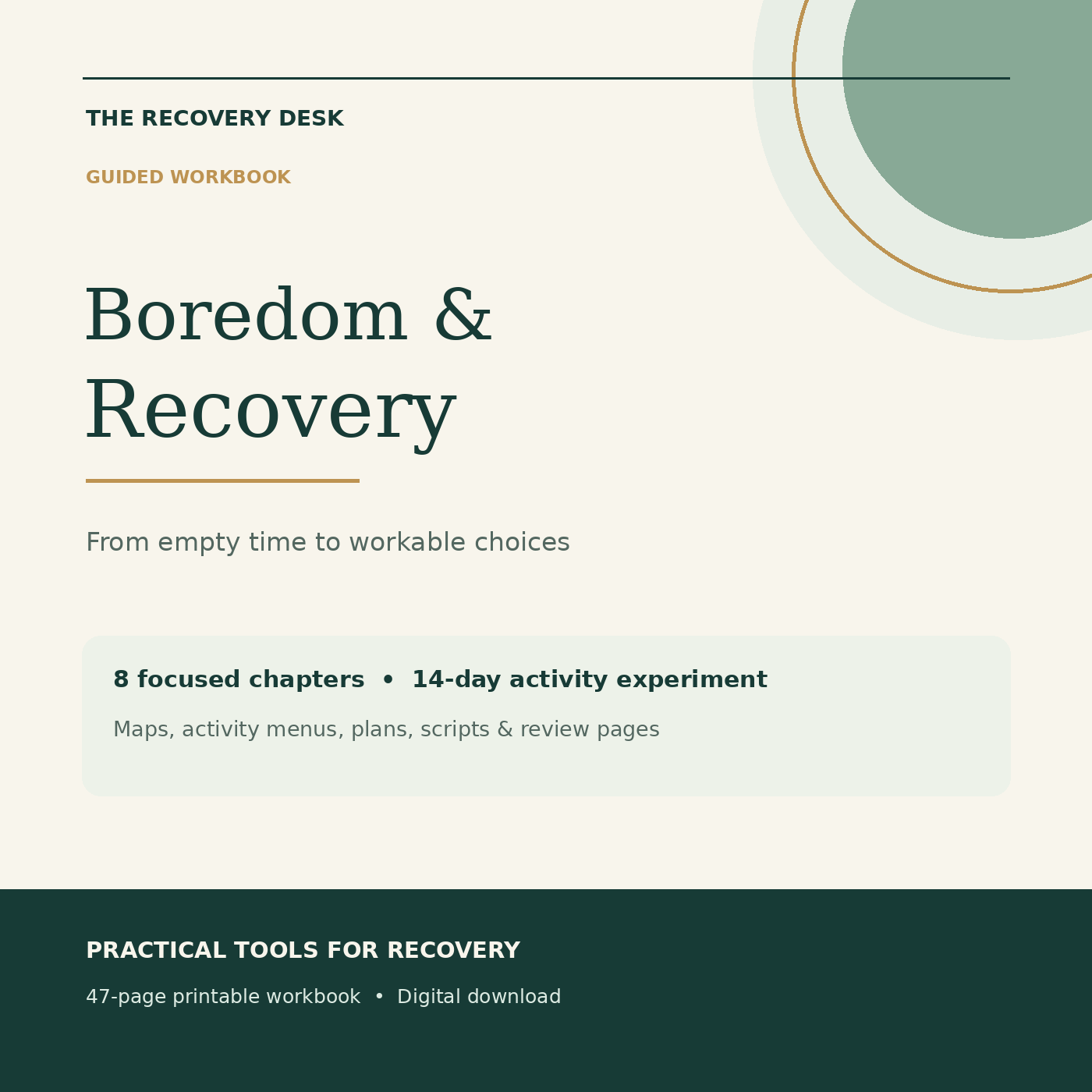
Boredom and Recovery
Boredom & Recovery
A Practical Recovery Workbook for Managing Empty Time, Cravings & Daily Structure | 47-Page Printable PDF
Boredom can become a surprisingly difficult part of recovery.
When substance use previously filled large parts of the day, removing it can leave behind long stretches of empty time.
Evenings may suddenly feel much longer.
Weekends can become difficult to structure.
Plans may fall through, energy may be low, and activities that used to feel enjoyable may not feel the same right away.
For some people, boredom can also become connected with cravings, loneliness, restlessness, or thoughts about returning to substance use.
Boredom & Recovery is a practical, 47-page guided workbook designed to help individuals understand what their boredom is actually signalling, identify higher-risk periods of unstructured time, build realistic activity options, and create practical plans for moments when boredom begins to feel connected with substance use urges. 49_boredom-and-recovery-workbook
Through eight focused chapters, printable worksheets, comparison exercises, action plans, a 14-day activity experiment, low-cost activity libraries, and reusable personal planning pages, this resource helps you move from “I have nothing to do” toward a clearer understanding of what you may actually need.
Sometimes boredom means you need stimulation.
Sometimes it means connection.
Sometimes you are exhausted and need rest.
Sometimes the problem is not boredom at all, but loneliness, lack of purpose, or being in an environment that makes substance use more accessible.
This workbook helps you explore those differences without treating boredom as a personal failure.
WHAT’S INCLUDED?
1. Notice the Boredom Pattern
Boredom can mean more than simply having nothing to do.
It may involve under-stimulation, loneliness, restlessness, fatigue, loss of purpose, or a routine that no longer fits your life.
This chapter helps you identify what is happening underneath the feeling.
Explore:
- When boredom feels most connected with substance use urges.
- How boredom shows up in your body, thoughts, and mood.
- Whether the strongest need is stimulation, connection, rest, purpose, or relief.
- What you have already tried.
- What happened in the hour after you responded.
- Which situations feel mild compared with situations that feel more difficult.
Includes two printable worksheets and an action-planning page for creating a simple if-then response to a common boredom pattern.
The goal is to understand the need before automatically trying to fill the time.
2. Map the High-Risk Hours
An empty calendar is not always the main problem.
Certain periods may be more difficult than others.
The transition after work, late evenings, weekends, paydays, cancelled plans, or long periods of waiting may carry different risks.
This chapter helps you map the hours around boredom and cravings.
Explore:
- Identifying your most unstructured time windows.
- Recognizing places, routes, people, devices, or access to money that may make those periods harder.
- Noticing what tends to happen shortly before an urge grows.
- Changing your location or routine.
- Planning for unexpected cancellations.
- Creating safer alternatives for predictable gaps.
Includes worksheets comparing weekday transitions, weekend gaps, evenings alone, and cancelled plans, plus a practical action page.
3. Build an Activity Menu That Actually Fits
Activity planning is not a test of whether you can force yourself to feel happy.
Some activities may not feel enjoyable immediately, especially during major changes in routine or early recovery.
Instead of asking only “Was this fun?”, this chapter encourages you to ask whether an activity was useful.
Explore:
- Activities that have held your attention in the past.
- No-cost options.
- Activities for low, medium, and higher energy.
- Connection, movement, creativity, and practical tasks.
- Activities you can try briefly without committing to an entire afternoon.
- How to rate usefulness rather than enjoyment alone.
Includes printable activity-mapping worksheets and an action plan for choosing three small experiments.
You can try something for ten minutes and stop without calling that a failure.
4. Work With Real-Life Barriers
Many activity suggestions assume you have spare money, transportation, stable housing, privacy, unlimited energy, or easy access to community spaces.
That will not be true for everyone.
This chapter helps you build plans around the resources you actually have.
Explore:
- What makes common activity advice unrealistic for you.
- Free or low-cost public spaces.
- Options for days when energy is low.
- Activities that do not require private space.
- Alternatives when weather or transportation becomes a barrier.
- People who may be able to help with access, childcare, equipment, or transportation.
Includes worksheets for situations such as having no money, low energy, no private space, or no transportation.
The action plan helps you create both a free version and a five-minute version of an activity.
5. Separate Boredom From Loneliness
Sometimes “I need something to do” actually means “I need another person.”
An activity may distract you temporarily without addressing a need for connection or belonging.
This chapter helps you explore the difference between being alone comfortably and feeling isolated.
Explore:
- When being alone feels restful versus risky.
- Low-pressure people or settings.
- Short messages you can send without explaining everything.
- Boundaries that make connection feel safer.
- Peer or mutual-help options.
- Professional support when additional assistance is needed.
Includes worksheets for exploring one-line messages, shared public spaces, peer groups, and professional contacts.
The action plan helps you prepare one connection step and a backup if the person does not respond.
6. Create a Flexible Daily Rhythm
Structure can reduce long periods of exposed time, but a rigid schedule may become difficult to maintain on a hard day.
This chapter focuses on building a few reliable anchors instead.
Explore:
- Parts of your day that already happen consistently.
- Wake-up or morning anchors.
- Meals and basic physical needs.
- Movement or fresh air.
- Social connection.
- Evening transitions and wind-down routines.
- What to do when the original plan is interrupted.
Includes printable worksheets for morning anchors, mid-day resets, evening transitions, and disrupted days.
The action plan encourages you to begin with only two anchors and review how they work before adding more.
7. Respond When Boredom Becomes an Urge
When boredom begins turning into a strong craving or substance use urge, finding the perfect hobby is no longer the priority.
The immediate goal becomes creating time, changing the environment, reducing access, and contacting appropriate support.
Explore:
- Recognizing your early warning signs.
- Identifying an environment change you can make within five minutes.
- Preparing the exact words you might use when contacting someone.
- Planning the first five minutes.
- Planning the next ten minutes.
- Identifying higher-support options when the urge remains strong.
- Knowing when professional or urgent help is needed.
Includes worksheets for mapping your immediate response and an action plan for writing and rehearsing an if-then plan.
The workbook encourages you to practise the plan on an easier day so that it is more familiar when you actually need it.
8. Make Room for Meaning
Recovery can feel empty when everyday life becomes focused entirely on not using substances.
Avoiding use may be important, but many people also need something to move toward.
Purpose does not have to mean a career, a major achievement, or completely reinventing your life.
Small roles, interests, curiosity, learning, contribution, and care can give a week more shape.
Explore:
- What matters to you beyond staying safe today.
- Interests or roles you may want to revisit.
- Small contributions that fit your current circumstances.
- Curiosity and learning.
- Caring for yourself or someone else.
- Identifying what makes an activity worth repeating.
Includes worksheets exploring curiosity, contribution, learning, and care, along with an action plan for choosing one small values-linked activity.
A 14-DAY ACTIVITY EXPERIMENT
The workbook also includes a structured 14-day experiment designed to help you test different responses to boredom rather than simply guessing what might work.
Each day introduces one small activity or observation.
The experiment includes:
- Day 1: Notice one bored moment without judging it.
- Day 2: Try one activity for ten minutes.
- Day 3: Change your environment for an exposed period.
- Day 4: Try a low-pressure connection step.
- Day 5: Choose an activity that matches your energy.
- Day 6: Try a no-cost option.
- Day 7: Review the patterns you have noticed.
- Day 8: Prepare for one predictable gap in your schedule.
- Day 9: Introduce a small amount of novelty.
- Day 10: Check food, water, sleep, movement, and pain before automatically labelling the feeling as boredom.
- Day 11: Try one action connected with a value or meaningful role.
- Day 12: Reach out for support before a difficult period begins.
- Day 13: Practise using your backup plan when Plan A changes.
- Day 14: Review the experiment and identify three options worth carrying forward.
Each activity includes space to rate usefulness and compare your urge level before and after.
The purpose is not to prove that every activity works.
It is to learn which options are worth keeping, changing, or replacing.
LOW-COST & LOW-ENERGY ACTIVITY LIBRARY
The workbook includes additional activity pages with practical ideas for different amounts of time and energy.
Two-Minute Options
Examples include changing rooms, opening a window, drinking water, playing one song, gently stretching, or sending one message.
Ten-Minute Options
Explore activities such as a short walk, browsing at a library, tidying one surface, sketching, completing a puzzle, preparing a simple snack, or taking a shower.
Thirty-Minute Options
Ideas include community spaces, free events, cooking, nature routes, peer meetings, or small repair projects.
The workbook also includes options focused specifically on:
- Social connection.
- Purpose.
- Curiosity.
- Learning.
- Helping others.
- Caring for a pet or plant.
- Community participation.
Blank sections allow you to add your own activities rather than relying only on suggested ideas.
YOUR PERSONAL BOREDOM RESPONSE MENU
One of the final pages is designed to be kept somewhere easy to access.
Build your own response menu for four different needs:
- When you need stimulation.
- When you need connection.
- When you need rest or regulation.
- When you need meaning or accomplishment.
This creates a personalized list of options you can return to before boredom becomes a stronger urge.
YOUR HIGH-RISK TIME PLAN
The workbook also includes a dedicated planning page for situations when boredom and craving begin appearing together.
Use it to identify:
- Your early warning signs.
- The environment you want to move away from.
- The environment you want to move toward.
- The person or service you will contact.
- The words you can use when asking for support.
- Your next safer step if the first plan does not work.
You can keep the completed page somewhere accessible or share selected parts with a trusted support person if that feels helpful.
WHO IS THIS WORKBOOK FOR?
This resource may be particularly helpful for:
- Individuals beginning or continuing substance use recovery.
- People who notice boredom is sometimes connected with cravings.
- Individuals transitioning out of withdrawal management, residential stabilization, or treatment.
- People who suddenly have more unstructured time after reducing or stopping substance use.
- Individuals who struggle with evenings, weekends, or other predictable gaps.
- People who feel that their usual hobbies are not enjoyable right now.
- Individuals experiencing boredom alongside loneliness or isolation.
- People with limited money, transportation, energy, housing stability, or private space.
- Individuals who want a practical activity plan rather than a generic list of hobbies.
- Anyone looking to develop more structure, connection, and meaning during recovery.
The workbook can be completed independently or alongside a trusted support person or appropriate professional.
HOW TO USE THIS WORKBOOK
You do not need to complete all 47 pages in order.
If boredom is affecting you right now, begin with the chapter that most closely matches what is happening.
If you do not understand why certain periods feel difficult, begin with the boredom-pattern and high-risk-hours sections.
If you know when boredom occurs but do not know what to do instead, begin building your activity menu.
If money, fatigue, transportation, housing, disability, pain, or access make typical activity suggestions unrealistic, start with the real-life barriers chapter.
If you think boredom may actually be loneliness, begin with the connection exercises.
If your days feel completely unstructured, try the flexible daily rhythm section.
If boredom is already becoming a strong urge, prioritize the high-risk planning section and appropriate support.
You can then use the 14-day experiment to test different strategies and gradually build a personalized boredom response menu.
You do not need to complete every exercise.
Write, draw, talk through an answer, use a hypothetical example, or skip a page that does not fit.
PRODUCT DETAILS
- Format: Digital PDF download
- Length: 47 pages
- Includes: 8 focused recovery chapters
- Worksheets: Two guided worksheets per chapter
- Action planning: Individual action plan for each chapter
- Additional materials: 14-day activity experiment, low-cost activity library, personalized boredom response menu, high-risk time plan, fictional examples, and evidence/further-reading page
- Topics: Boredom, cravings, unstructured time, activity planning, loneliness, daily routines, practical barriers, support, and meaning
- Language: English
- Delivery: Instant digital download
- Intended audience: Individuals navigating substance use recovery
- Use: Printable for personal use
No physical product will be shipped.
BOREDOM DOES NOT MEAN YOUR RECOVERY IS FAILING.
When substance use changes, everyday life can feel strangely quiet.
Things that once filled hours may no longer be part of your routine.
Activities may not feel rewarding immediately.
You may discover that what you called boredom was sometimes loneliness, exhaustion, restlessness, lack of purpose, or simply not knowing what to do next.
That does not mean you need to fill every minute.
It means you can begin learning which kinds of activities, environments, routines, and connections make difficult periods more manageable.
Boredom & Recovery is designed to help you build those options gradually.
Not by creating a perfect schedule.
Not by forcing yourself to have fun.
But by noticing what you need, testing realistic alternatives, and preparing for the hours when returning to substance use starts to feel more tempting.
Understand the pattern. Build your options. Make empty time more workable.
IMPORTANT INFORMATION & LICENSING
This workbook is an educational resource intended for general recovery-related reflection, activity planning, coping skills exploration, behavioural activation-style exercises, and practical relapse-prevention planning.
It does not replace professional medical care, individualized counselling, psychotherapy, clinical assessment, medication management, withdrawal treatment, or emergency services.
The workbook is not a clinically validated treatment manual or independently tested treatment intervention.
Activities should be adapted to your available time, money, housing, transportation, disability, pain, culture, energy, safety, and other practical circumstances.
If boredom or unstructured time is accompanied by strong substance use urges that feel difficult to manage, consider contacting a counsellor, peer worker, healthcare professional, or trusted support person.
If you are experiencing a suspected overdose, severe or unsafe withdrawal, a medical emergency, or immediate danger, contact emergency services (911 in Canada or your local emergency number). For suicide crisis support in Canada, call or text 988.
No activity, workbook exercise, or planning strategy can guarantee abstinence, eliminate cravings, prevent relapse, or ensure a particular recovery outcome.
Your purchase includes a digital PDF for personal use only. You may print pages for your own use. Organizational distribution, resale, unauthorized redistribution, or marketing adapted copies as your own product is not permitted without separate written permission.